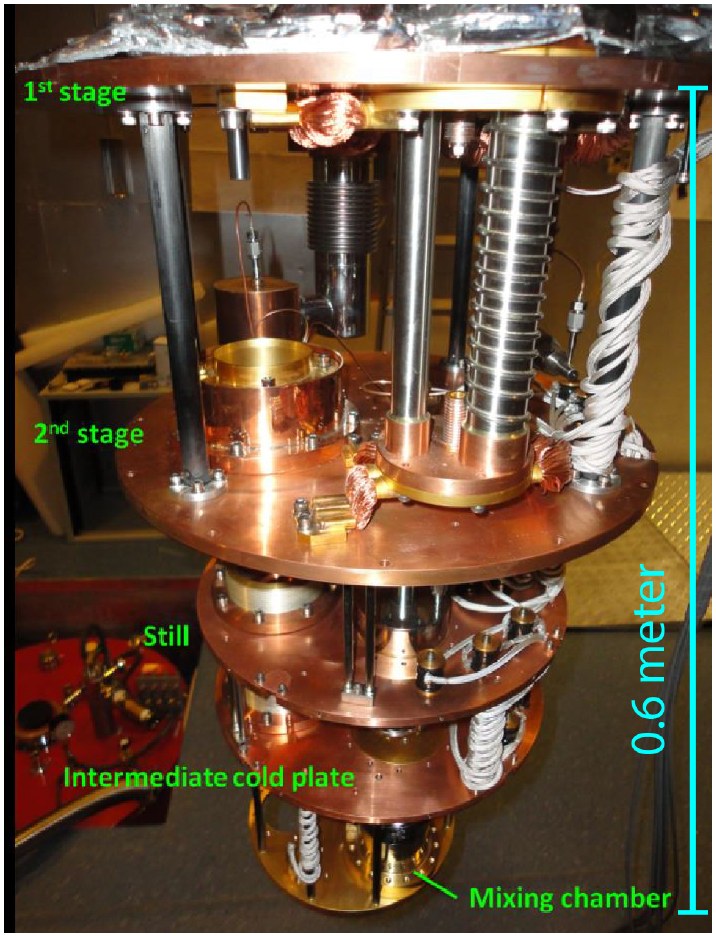
Getting to about 1 K. A pulse-tube cryocooler, a closed-cycle refrigerator with no liquid helium to refill, cools the first two plates to roughly 50 K and 3 K. The incoming helium is then condensed and expanded through a flow restriction, which takes it below about 1 K.
The key trick. Below about 0.87 K, a mixture of helium-3 and helium-4 separates into two liquid phases, like oil and water: a lighter phase that is almost pure helium-3 floating on a heavier phase that is mostly helium-4 with a few percent helium-3 dissolved in it. When a helium-3 atom crosses from the rich phase into the dilute phase, it absorbs heat, just as a molecule does when a liquid evaporates. That crossing happens in the mixing chamber, the coldest point of the fridge.
Keeping it going. The dilute phase connects to the still, held near 0.7 K. There, helium-3 evaporates far more readily than helium-4, so pumping on the still removes almost only helium-3. That keeps drawing helium-3 across the phase boundary in the mixing chamber. The pumped gas returns down the condensing line, is pre-cooled by heat exchangers against the outgoing dilute stream, and rejoins the rich phase: a continuous cycle.
Cooling power. The heat a dilution fridge can absorb falls roughly as the square of temperature (Q̇ ∝ ṅ3T², where ṅ3 is the helium-3 flow). At 10 mK the budget is microwatts, so every wire, support and radiation path matters far more than at 2 K.